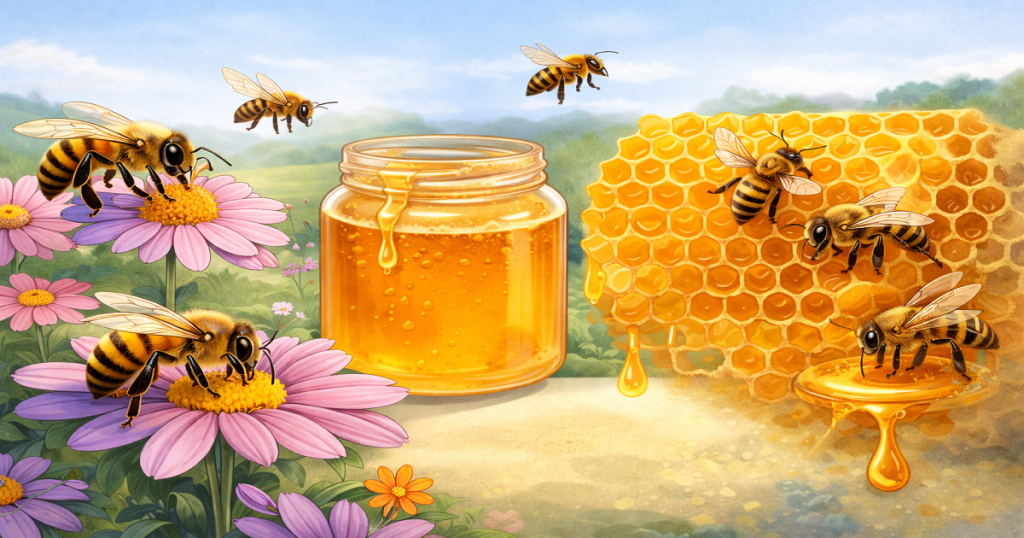
If you’ve ever asked, ” How long do bees take to make honey, you’re tapping into one of the most fascinating processes in nature. What looks like a simple jar of honey on your table is actually the result of thousands of hours of coordinated labor, biological precision, and environmental interaction inside a bee colony.
The primary producers, the Honey bee (Apis mellifera), don’t just “make” honey quickly. Instead, they transform nectar through a complex system involving enzyme activity, moisture reduction, hive temperature regulation, and collective colony efficiency. Every drop of honey represents the combined effort of thousands of worker bees, each performing specialized roles within the beehive ecosystem.
So, how fast do bees make honey in real-world conditions? Why does it sometimes take weeks—or even months? And what hidden biological mechanisms control this process?
In this comprehensive guide, we’ll break down:
- The exact timeline of honey production
- The science behind nectar-to-honey conversion
- The role of worker bees and hive structure
- The factors that speed up or slow down production
By the end, you’ll understand not just how long it takes—but why.
Quick Answer: How Long Do Bees Take To Make Honey?
Bees typically take anywhere from a few days to several weeks to convert nectar into fully ripened honey.
However, this answer varies depending on:
- Nectar availability (nectar flow)
- Weather conditions
- Colony size and strength
- Hive efficiency and temperature control
In peak conditions, bees can begin producing honey within 3–7 days, but fully filling a hive frame may take weeks or longer.
The Full Honey-Making Process (Deep Scientific Breakdown)
To truly understand honey production time, you need to look inside the honey-making process at a biological level.
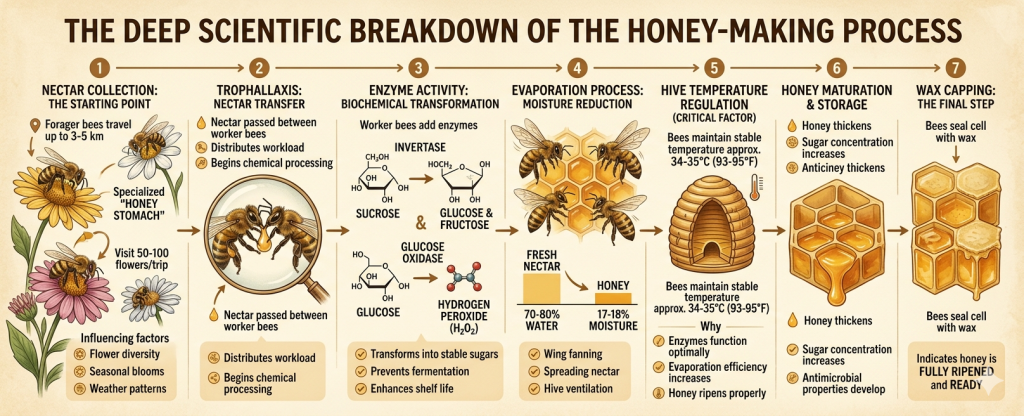
Nectar Collection: The Starting Point
Everything begins with nectar gathering from flowering plants.
- Forager bees travel up to 3–5 km from the hive
- Each bee collects nectar in a specialized “honey stomach.”
- A single trip may involve visiting 50–100 flowers
This stage depends heavily on:
- Flower diversity
- Seasonal bloom cycles
- Weather patterns
During strong nectar flow, production accelerates dramatically.
Trophallaxis: Nectar Transfer Between Bees
Once inside the hive, nectar is passed from one bee to another in a process called trophallaxis. This step is critical because:
- It distributes nectar across worker bees
- Begins chemical processing
- Reduces workload for individual bees
This is where colony efficiency becomes a major factor in production speed.
Enzyme Activity: The Biochemical Transformation
This is one of the most important—and often overlooked—stages. Worker bees add enzymes such as:
- Invertase → converts sucrose into glucose and fructose
- Glucose oxidase → produces hydrogen peroxide (antibacterial property)
Why This Matters
- Transforms nectar into stable sugars
- Prevents fermentation
- Enhances shelf life
This biochemical stage defines the true transformation from nectar to honey.
Evaporation Process: Moisture Reduction
Fresh nectar contains about 70–80% water, which is far too high for storage.
Bees reduce this to around 17–18% moisture through:
- Wing fanning (air circulation)
- Spreading nectar across honeycomb cells
- Hive ventilation
Hive Temperature Regulation (Critical Factor)
Bees maintain a stable hive temperature of approximately 34–35°C (93–95°F).
This is essential because:
- Enzymes function optimally at this temperature
- Evaporation efficiency increases
- Honey ripens properly
Without precise temperature control, honey production slows or fails.
Honey Maturation & Storage
Once moisture is reduced:
- Honey thickens
- Sugar concentration increases
- Antimicrobial properties develop
Bees store the honey in honeycomb cells, spreading it thinly for final evaporation.
Wax Capping: The Final Step
When honey reaches the correct consistency:
- Bees seal the cell with wax (called wax capping)
This indicates:
The honey is fully ripened and ready
How Fast Do Bees Make Honey in Real Conditions?
Realistic Timeline:
| Stage | Time Required |
| Nectar collection | Hours to days |
| Enzyme conversion | 1–3 days |
| Evaporation | 3–7 days |
| Full honey maturation | 1–3 weeks |
During peak summer, bees can produce honey much faster due to strong nectar flow.
How Much Work Goes Into Honey Production?
This is where the scale becomes astonishing.
Key Facts
- One bee produces about 1/12 teaspoon of honey in its lifetime
- A colony may contain 20,000–60,000 bees
- Bees collectively fly thousands of kilometers
Nectar to Honey Ratio
- 2–3 kg of nectar → 1 kg of honey
How Many Bees Does It Take to Make Honey?
To produce a single jar of honey:
- Thousands of worker bees are involved
- Millions of flower visits are required
This highlights the extraordinary hive productivity and cooperative behavior.
Colony Roles: Division of Labor in Honey Production
A bee colony operates like a highly efficient system.
Worker Bee Roles:
- Forager bees → collect nectar
- House bees → process nectar
- Fanner bees → regulate airflow
- Builder bees → create honeycomb
Each role directly affects how long it takes bees to make honey.
Factors That Affect Honey Production Time
Nectar Flow & Floral Sources
- Abundant flowers = faster production
- Different plants produce different nectar qualities
Weather Conditions
- Warm, dry weather speeds up evaporation
- Rain reduces foraging
Colony Strength
- Larger colonies produce more honey
- Strong colonies work more efficiently
Hive Health
- Disease-free colonies perform better
- Stress reduces productivity
Environmental Stressors
- Pesticides
- Habitat loss
- Climate variability
Seasonal Honey Production Cycle
Understanding the beekeeping season is essential.
Spring:
- The colony builds a population
Summer:
- Peak nectar flow
- Maximum honey production
Late Summer/Fall:
- Production slows
- Bees prepare for winter
Real-World Beekeeper Insights
From practical beekeeping experience:
Observations:
- Strong colonies can fill a honey super in 1–2 weeks
- Weak colonies may take months
- Weather changes can halt production entirely
Professional Tips:
- Place hives near diverse flowering plants
- Ensure proper ventilation
- Monitor colony strength regularly
Common Mistakes:
- Expecting fast honey production
- Ignoring seasonal patterns
- Poor hive placement
Step-by-Step Summary
Bees collect nectar from flowers
Nectar is transferred between bees (trophallaxis)
Enzymes break down sugars
Moisture is evaporated
Honey is stored in a honeycomb
Cells are sealed with wax
Comparison Table: Fast vs Slow Honey Production
| Factor | Fast Production | Slow Production |
| Nectar Supply | High | Low |
| Weather | Warm & dry | Cold or rainy |
| Colony Size | Large | Small |
| Hive Health | Strong | Weak |
| Temperature | Stable | Fluctuating |
Frequently Asked Questions (FAQ)
How long does it take bees to make honey?
Typically, a few days to several weeks, depending on conditions.
How fast do bees make honey in summer?
Much faster due to strong nectar flow—sometimes within days.
How long does it take to fill a hive with honey?
Several weeks to months, depending on colony strength.
How much nectar is needed to make honey?
About 2–3 kg of nectar for 1 kg of honey.
How many bees are needed to make honey?
Thousands of bees contribute to production.
What is trophallaxis?
It’s the process of nectar transfer between bees.
Why is moisture reduction important?
It prevents fermentation and preserves honey.
Can bees make honey year-round?
No, mainly during warm seasons with active flowers.
What affects honey production speed?
Weather, nectar availability, colony strength, and hive conditions.
How do bees know honey is ready?
They seal it with wax once the moisture is low enough.
Conclusion
So, how long do bees take to make honey? The answer depends on a complex interplay of biology, environment, and colony dynamics—but typically ranges from a few days to several weeks.
What makes this process remarkable is not just the timeline, but the precision behind it. From enzyme-driven chemical transformation to controlled evaporation and hive thermoregulation, bees operate with extraordinary efficiency. Their ability to convert nectar into a stable, nutrient-rich food source reflects one of nature’s most advanced cooperative systems.
Understanding this process not only answers the question but also deepens appreciation for the incredible work behind every drop of honey.