You’re sitting outside enjoying a drink when a buzzing insect suddenly appears. It circles your food, lands briefly, and then takes off again. In that moment, one question matters: Is it a harmless honey bee or an aggressive yellow jacket?
Understanding the difference between these two insects is more important than most people realize. While both belong to the group of stinging insects, their behavior, purpose, and level of risk are completely different. Misidentifying them can lead to unnecessary fear—or worse, painful and repeated stings.
The Honey Bee vs Yellow Jacket comparison is one of the most searched topics in insect identification because people want quick, clear answers that help them stay safe outdoors.
In this comprehensive guide, you’ll learn:
- How to identify a honey bee vs. a yellow jacket instantly
- The real differences in behavior and aggression
- A detailed yellow jacket vs bee sting comparison
- What attracts yellow jackets to humans
- Practical, expert-backed tips to avoid stings
By the end, you’ll not only understand these insects—you’ll know exactly how to respond when you encounter them in real life.
What Is a Honey Bee?
When people think of bees, they usually imagine a calm insect moving between flowers. That image accurately represents the Western honey bee, one of the most important pollinators in the natural world.
Honey bees are not pests—they are essential contributors to agriculture, biodiversity, and food production.
Key Characteristics
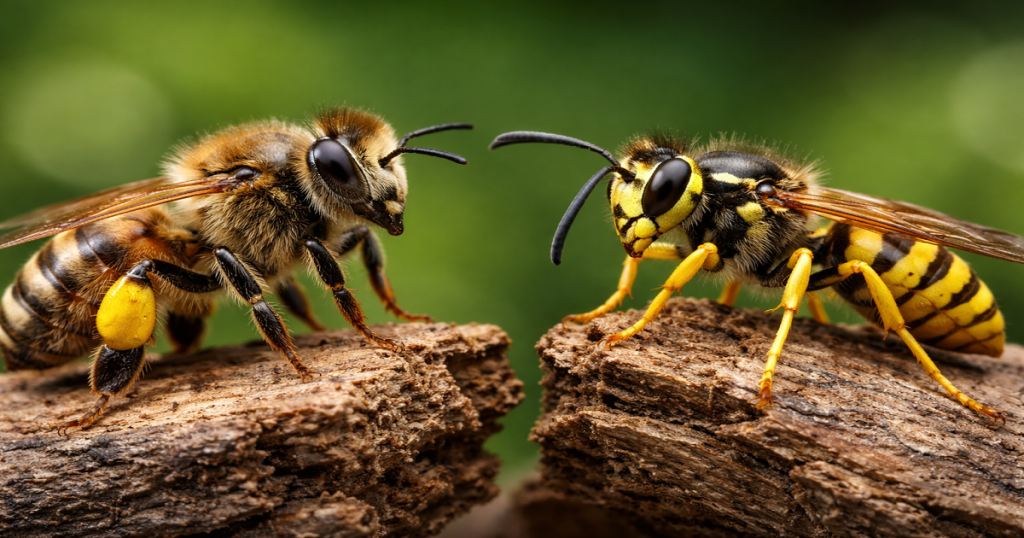
Fuzzy, pollen-adapted body
Honey bees are covered in tiny hair-like structures that trap pollen as they move from flower to flower. This fuzzy appearance is a defining trait and plays a direct role in pollination ecology.
Golden-brown coloration with soft stripes
Their muted tones give them a less aggressive appearance compared to bright yellow insects. This coloration also helps them blend into natural environments.
Rounded body shape
Honey bees have a thicker, more compact abdomen, unlike the narrow, pointed shape of wasps.
Barbed stinger (single-use)
A honey bee’s stinger is barbed, which means it becomes lodged in the skin after use. This causes the bee to die, making stinging a last-resort defensive action.
Role in the Ecosystem
Pollination support
Honey bees are responsible for pollinating a large percentage of crops and wild plants, supporting the ecosystem.
Biodiversity maintenance
By enabling plant reproduction, they contribute to biodiversity.
Food supply stability
Many fruits, vegetables, and nuts depend directly on bee pollination.
Colony Behavior and Apiculture
Eusocial structure
Honey bees live in organized colonies with a queen, worker bees, and drones, demonstrating advanced colony behavior.
Apiculture (beekeeping)
Humans manage bee colonies for honey production and agricultural pollination, highlighting their economic importance.
Honey bees are focused almost entirely on survival and foraging—not human interaction. Most stings happen only when their hive is disturbed.
What Is a Yellow Jacket?
If honey bees represent calm efficiency, yellow jackets represent aggressive survival. The Eastern yellow jacket is a member of the wasp family and is widely known for its bold, sometimes hostile behavior.
Key Characteristics
- Smooth, shiny body
Unlike bees, yellow jackets lack body hair, giving them a sleek and reflective surface. - Bright yellow and black markings
Their vivid colors act as a warning sign, signaling their ability to sting and defend aggressively. - Slim waist and pointed abdomen
A classic feature of bee vs wasp differences, making them appear more “sharp” and agile. - Reusable stinger
Yellow jackets can sting multiple times without harm to themselves, significantly increasing their threat level.
Behavior and Feeding Habits
Predatory wasps
They hunt insects and scavenge food, making them effective pest controllers.
Attraction to human food
They are commonly drawn to sugary drinks, meat, and garbage, especially during outdoor activities.
High insect aggression
Yellow jackets are easily provoked and can attack in groups.
If an insect is hovering persistently around your food or drink, it is almost always a yellow jacket—not a honey bee.
Honey Bee vs Yellow Jacket Identification
Correct insect identification can prevent panic and reduce the risk of stings.
Visual Identification
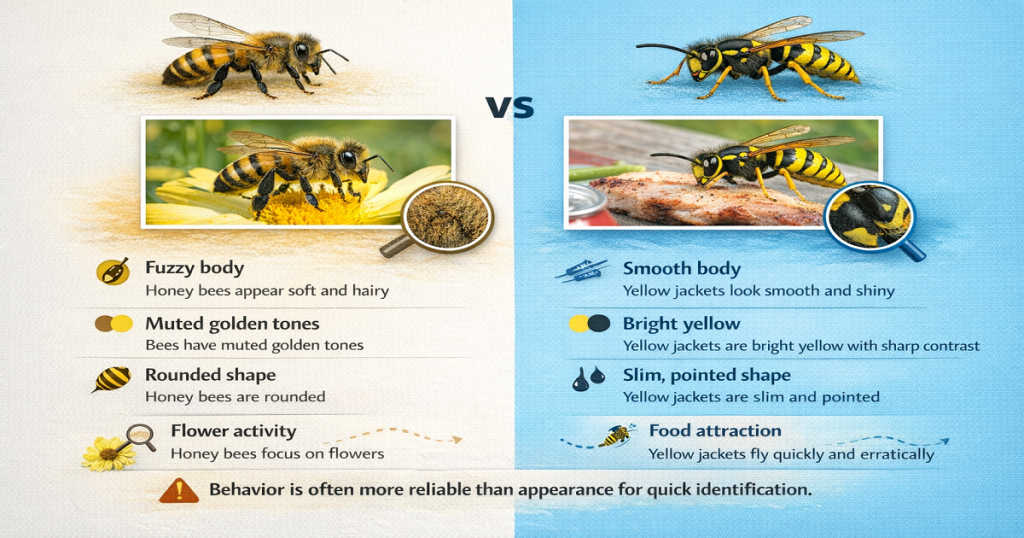
Fuzzy vs smooth body
Honey bees appear soft and hairy, while yellow jackets look smooth and shiny.
Color differences
Bees have muted golden tones, while yellow jackets are bright yellow with sharp contrast.
Body shape
Honey bees are rounded; yellow jackets are slim and pointed.
Behavioral Clues
Flower activity vs food attraction
Honey bees focus on flowers, while yellow jackets target human food.
Flight patterns
Bees move slowly and hover; yellow jackets fly quickly and erratically. Behavior is often more reliable than appearance for quick identification.
Key Differences Between Honey Bees and Yellow Jackets
| Feature | Honey Bee | Yellow Jacket |
| Body Texture | Fuzzy | Smooth |
| Color | Golden-brown | Bright yellow |
| Behavior | Calm | Aggressive |
| Diet | Nectar & pollen | Meat & sugar |
| Sting | One-time | Multiple |
| Role | Pollinator | Predator |
Key Takeaways
Honey bees support life through pollination
They are essential for plant reproduction and agriculture.
Yellow jackets control pests but create risks
Their aggressive nature makes them dangerous near humans.
Behavior and Aggression Differences
Understanding behavior helps explain why encounters differ so drastically.
Honey Bee Behavior
Defensive rather than aggressive
Honey bees sting only when their colony is threatened.
Focused on foraging behavior
Their primary goal is to collect nectar and pollen.
Yellow Jacket Behavior
Highly territorial
They aggressively defend their nests.
Food-driven aggression
They actively seek out human food sources.
Pheromone signaling
When threatened, they release signals that trigger group attacks.
Why Aggression Increases
- Food scarcity in late summer
- Colony protection instincts
- Increased competition
Sting Comparison: Honey Bee vs Yellow Jacket
Stings are where the biggest safety differences occur.
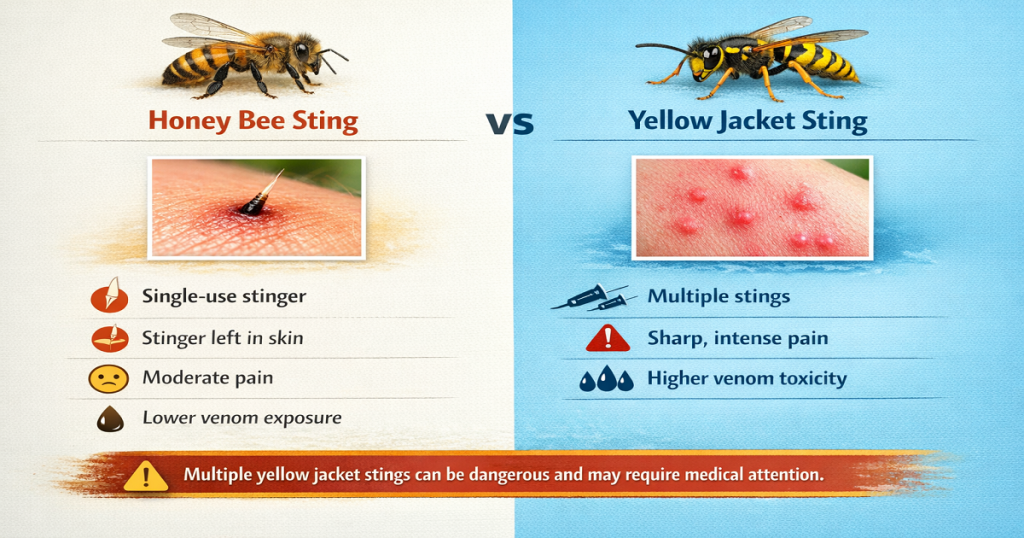
Honey Bee Sting
Single-use stinger
Leaves with a stinger embedded in the skin.
Moderate pain level
Usually manageable for most people.
Lower venom exposure
Only one injection of venom.
Yellow Jacket Sting
Multiple stings possible
Can sting repeatedly in seconds.
Sharp, intense pain
Often described as more aggressive.
Higher venom toxicity risk
Multiple stings increase severity.
Multiple yellow jacket stings can be dangerous and may require medical attention.
Nesting and Habitat Differences
Honey Bee Hive
- Wax-based structure
- Found in trees or managed boxes
- Long-term colony lifecycle
Yellow Jacket Nest
- Paper-like material
- Often underground or hidden
- Seasonal colonies
Nest Behavior
- Honey bees defend, but don’t chase far
- Yellow jackets aggressively protect their territory
How to Avoid Yellow Jacket Stings Outdoors
It is very important to know how to avoid bee stings outdoors. Here we discussed some steps to avoid bee stings.
Prevention Steps
Keep food covered
Open food attracts yellow jackets quickly.
Avoid strong scents
Perfumes and lotions can draw them in.
Wear neutral clothing
Bright colors may trigger attention.
Stay calm and avoid swatting
Sudden movements increase aggression.
What Attracts Yellow Jackets
Sugary drinks
Meat and protein
Garbage and waste
Ecological Roles and Benefits
Honey Bees
- Support pollination
- Maintain biodiversity
- Sustain food production
Yellow Jackets
- Control pest populations
- Break down organic matter
- Contribute to ecosystem balance
Practical Insights & Real-World Experience
Common Mistakes
- Swatting insects aggressively
- Ignoring nearby nests
- Misidentifying bees as threats
Expert Tips
- Observe before reacting
- Maintain distance from nests
- Use professionals for removal
Frequently Asked Questions (FAQ)
1. How to identify honey bees vs. yellow jackets?
Look for a fuzzy body (bee) versus a smooth, shiny body (yellow jacket), and observe whether it’s near flowers or food.
2. Why are yellow jackets more aggressive than bees?
They are territorial, food-driven, and use pheromone signaling to coordinate attacks.
3. Do yellow jackets sting more than honey bees?
Yes, they can sting multiple times, unlike honey bees.
4. Are honey bees dangerous to humans?
Only when provoked. They are generally calm and focused on foraging.
5. What attracts yellow jackets to humans?
Sugary foods, meat, garbage, and strong scents.
6. Which sting is worse?
Yellow jacket stings are typically more painful and dangerous due to repeated stings.
7. How to tell if a nest is bees or yellow jackets?
Bees build wax hives, while yellow jackets create paper-like nests, often underground.
Conclusion
The Honey Bee vs Yellow Jacket comparison highlights two very different insects that are often confused. Honey bees are gentle pollinators essential to life, while yellow jackets are aggressive predators that require caution.
By understanding their differences, recognizing their behavior, and following simple safety strategies, you can confidently enjoy outdoor spaces while minimizing risks.