Honey is one of the most natural and fascinating foods on Earth. But if you’ve ever stopped to think about it, you might wonder: how do bees make honey, and what actually happens inside a beehive?
At a simple level, bees collect nectar and turn it into honey. But in reality, the honey production process in bees is far more complex. It involves biology, chemistry, teamwork, and environmental control. Thousands of worker bees collaborate in a perfectly organized system to transform watery flower nectar into a thick, nutrient-rich, and long-lasting food source.
For beginners, understanding how bees make honey step by step helps you appreciate not only the science behind it, but also the incredible effort behind every spoonful.
In this guide, you’ll learn:
- How bees collect nectar from flowers
- How bees convert nectar into honey using enzymes
- The full process of nectar to honey conversion
- What happens inside a beehive during honey production
- Real-world insights from beekeeping experience
Let’s explore this amazing natural process in detail.
What Is Honey and Why Do Bees Make It?
What is honey?
Honey is a sweet, thick substance produced by honey bees from plant nectar. It mainly contains:
- Glucose and fructose
- Small amounts of enzymes
- Organic acids
- Minerals and antioxidants
Unlike nectar, honey is:
- Low in water content (~18%)
- Highly stable
- Naturally resistant to bacteria
Why do bees make honey?
Bees produce honey as a long-term energy reserve. A bee colony relies on stored honey to survive:
- Winter seasons
- Rainy or dry periods
- Times when flowers are not available
A strong colony may consume 20–30 kilograms of honey per year, especially in colder climates.
Step-by-Step: How Bees Make Honey
Understanding how bees produce honey becomes easier when broken into clear steps.
Step 1: Nectar Collection – The Foraging Stage
The process begins with forager bees. These worker bees leave the hive in search of nectar-rich flowers.
How bees collect nectar:
- Bees use a long tongue (proboscis) to suck nectar
- Nectar is stored in a special organ called the honey stomach
- Each trip can include visits to 50–100 flowers
Bees don’t just collect randomly. They communicate using the “waggle dance” to guide others to rich nectar sources. A bee can travel up to 3–5 kilometers (2–3 miles) from the hive.
Step 2: Nectar Storage and Initial Processing
Once nectar is collected, it is stored in the bee’s honey stomach, which is separate from its digestive stomach.
Inside this organ:
- Nectar begins to mix with enzymes
- The transformation process starts
Special glands called hypopharyngeal glands release enzymes that begin breaking down sugars.
Step 3: Enzyme Activity – Breaking Down Sugars
This is where the real chemistry happens. Fresh nectar contains mostly sucrose, a complex sugar. Key enzyme process: Invertase enzyme
Breaks sucrose into:
- Glucose
- Fructose
This process is known as sucrose breakdown. This makes honey easier to digest and more stable.
Step 4: Trophallaxis – Bee-to-Bee Transfer
When the forager returns to the hive, it passes the nectar to another worker bee.
This process is called:
Trophallaxis (bee regurgitation process)
What happens during trophallaxis:
- Nectar is transferred mouth-to-mouth
- Enzymes continue to mix
- Water content slowly reduces
This step may happen multiple times before the nectar is ready for storage.
Step 5: Advanced Chemical Transformation
Another important enzyme becomes active:
Glucose oxidase
This enzyme converts glucose into:
- Gluconic acid
- Hydrogen peroxide
These changes give honey:
- An acidic pH (around 3.5–4.5)
- Strong antimicrobial properties
This is why honey can last for years without spoiling.
Step 6: Evaporation Process – Moisture Reduction
At this stage, nectar is still too watery. Fresh nectar contains about:
70–80% water
But honey needs to have only:
-17–18% water
How do bees reduce moisture?
Bees:
- Spread nectar into thin layers in honeycomb cells
- Fan their wings rapidly to create airflow
If you stand near a hive, you may hear a constant humming sound. That’s bees actively ventilating the hive.
This process:
- Reduces water content
- Increases osmotic pressure
- Prevents microbial growth
Step 7: Nectar to Honey Conversion Ratio
A key fact that shows how much work is involved: 3–4 kilograms of nectar are needed to produce 1 kilogram of honey
Why?
- Most water is removed
- Sugars become highly concentrated
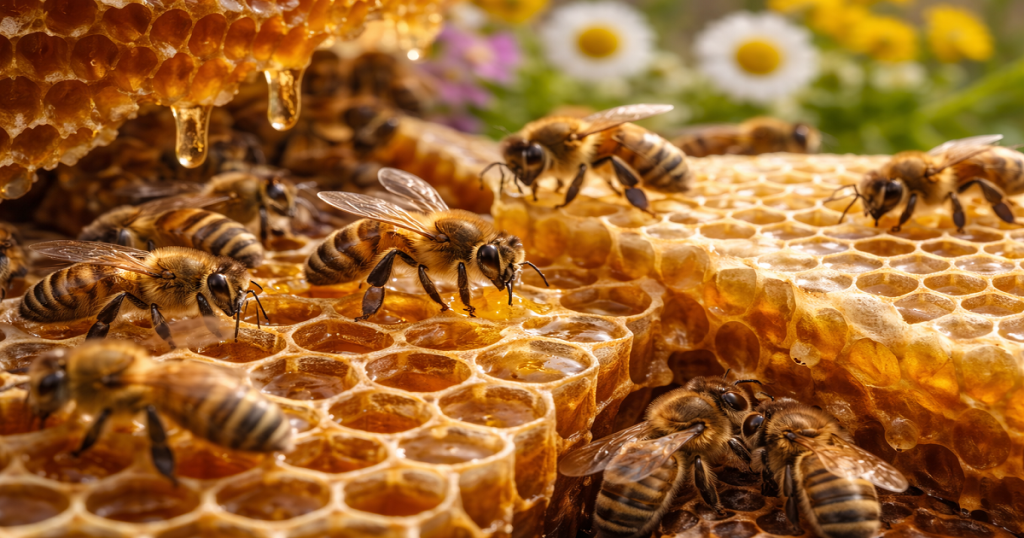
Step 8: Storage in Honeycomb Cells
Once thickened, the liquid becomes true honey. Bees store it in: Honeycomb cells
Honeycomb features:
- Hexagonal shape (space-efficient)
- Made from beeswax
- Located in upper hive areas
This is how honey is formed in a hive.
Step 9: Wax Capping – Sealing the Honey
When the honey reaches the correct thickness, bees seal the cells with wax.
This is called:
👉 Wax capping process
Why bees seal honey:
- Prevents moisture from entering
- Stops fermentation
- Preserves honey for long-term storage
Beekeepers only harvest honey after cells are fully capped.
What Happens Inside a Beehive During Honey Production?
A beehive is a highly organized system.
Key roles:
- Forager bees → collect nectar
- Worker bees → process nectar
- Ventilator bees → control airflow
Hive conditions:
- Temperature: around 35°C
- Controlled humidity
- Continuous air circulation
This system is known as hive thermoregulation.
How Many Flowers Does It Take to Make Honey?
This is one of the most surprising facts.
- 1 teaspoon of honey → about 2,000 flowers
- 1 pound of honey → about 2 million flowers
A single bee produces only 1/12 teaspoon of honey in its lifetime
Environmental Factors That Affect Honey Production
Honey production depends heavily on the environment.
1. Weather
- Rain reduces nectar availability
- Humidity slows evaporation
2. Flower Availability
- More flowers = more nectar
- Affects both quantity and taste
3. Temperature
- Ideal: 30–35°C
- Cold weather slows bee activity
4. Nectar Sugar Concentration
- Higher sugar content = better honey production
Types of Honey Based on Nectar Source
Different flowers produce different honey.
| Honey Type | Source | Flavor |
| Clover | Clover plants | Mild and sweet |
| Wildflower | Mixed flowers | Rich and complex |
| Mustard | Mustard crops | Slightly spicy |
| Acacia | Acacia trees | Light and delicate |
Why Honey Has Antimicrobial Properties
Honey resists bacteria because of:
- Low moisture content
- High sugar concentration
- Acidic pH
- Hydrogen peroxide production
This combination creates an environment where bacteria cannot survive.
Practical Insights from Beekeeping Experience
1. Humidity matters more than beginners think
High humidity slows the evaporation process.
2. Strong colonies produce more honey
More worker bees = better efficiency.
3. Timing is everything
Harvesting too early leads to watery honey.
4. Not all nectar becomes honey
Some nectar is used immediately for energy.
Common Mistakes Beginners Make
- Thinking nectar is already honey
- Ignoring enzyme activity
- Not understanding moisture reduction
- Harvesting uncapped honey
Quick Summary: How Bees Make Honey
Step-by-step process:
- Bees collect nectar from flowers
- Enzymes break down sugars
- Nectar is passed between bees
- Water content is reduced
- Honey is stored in a honeycomb
- Cells are sealed with wax
Nectar vs Honey (Comparison Table)
| Feature | Nectar | Honey |
| Water content | 70–80% | ~18% |
| Sugar type | Sucrose | Glucose + fructose |
| Stability | Low | High |
| Shelf life | Short | Long |
| Antimicrobial | Weak | Strong |
Frequently Asked Questions (FAQ)
How do bees turn nectar into honey?
They add enzymes, reduce the water content, and store it until it thickens.
What enzymes are used?
Invertase and glucose oxidase.
How long does it take?
From a few days to several weeks.
Why do bees regurgitate nectar?
To process and mix enzymes during trophallaxis.
How do bees dry nectar?
By fanning their wings to create airflow.
Why doesn’t honey spoil?
Because of low moisture, acidity, and antimicrobial compounds.
How much honey does a bee make?
About 1/12 teaspoon in its lifetime.
How far do bees travel?
Up to 3–5 kilometers from the hive.
What is wax capping?
Sealing honey cells with wax.
10. Can honey ferment?
Yes, if the moisture content is too high.
Conclusion
Now you understand how bees make honey step by step, from nectar collection to enzyme transformation and moisture reduction. What seems like a simple natural food is actually the result of complex biological processes and teamwork.
Every drop of honey represents:
- Thousands of flower visits
- Advanced enzyme activity
- Careful environmental control
Honey is not just food—it’s one of nature’s most efficient and fascinating creations.