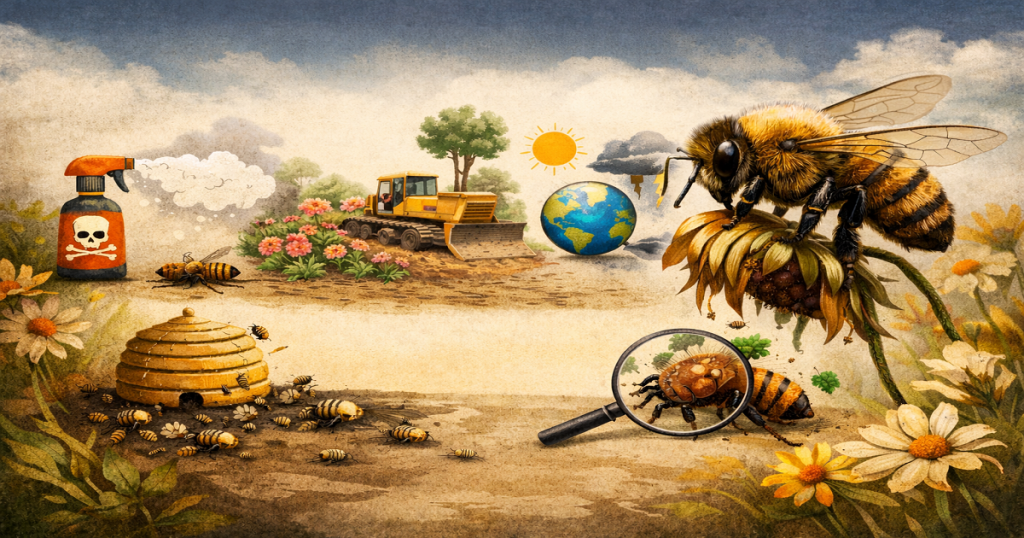
The question “why bees are dying” is no longer just an environmental concern—it’s a global crisis affecting food security, biodiversity, and the stability of entire ecosystems. Across continents, scientists, farmers, and organizations like the United Nations Environment Programme warn that the bee population decline is accelerating faster than previously expected.
Bees, especially Apis mellifera, are responsible for pollinating a significant portion of the world’s crops and wild plants. Yet both managed honey bee colonies and wild pollinators are disappearing due to a complex mix of environmental stressors.
This article goes beyond surface-level explanations. You’ll learn:
- The real causes of bee decline (and how they interact)
- The science behind Colony Collapse Disorder (CCD)
- Hidden biological factors affecting colony health
- The global impact on agriculture and ecosystems
- Practical, science-backed ways to help reverse the trend
What Does Bee Population Decline Really Mean?
Bee population decline refers to the widespread reduction in both managed and wild bee populations, including lower colony survival rates, reduced reproduction, and increased seasonal losses.
In practical terms:
- Beekeepers are losing colonies at higher annual rates
- Wild bee species are disappearing from natural habitats
- Pollination services are becoming less reliable
This is not just about bees dying—it’s about ecosystems losing a critical function.
The Core Causes of Bee Decline (And How They Interact)
One of the biggest misconceptions is that there is a single cause. In reality, the global bee decline is driven by synergistic effects—multiple stressors working together.
1. Pesticide Exposure (Neonicotinoids and Sublethal Effects)
Modern agriculture relies heavily on pesticides, particularly neonicotinoids.
What makes them dangerous?
Even when they don’t kill bees immediately, sublethal pesticide exposure:
- Damages navigation (bees can’t find their way back)
- Alters foraging behavior
- Suppresses immune systems
- Reduces queen fertility
Over time, this leads to weakened colonies that collapse under additional stress.
2. Parasites: The Role of Varroa destructor
Varroa mites are one of the most devastating threats to honey bees.
Lifecycle impact:
- Mites reproduce inside brood cells
- Feed on bee fat bodies (critical for immunity)
- Transmit viruses like Deformed Wing Virus
This creates a cascade effect:
weakened bees → increased disease → colony collapse
Pathogens, Viruses, and Immune Suppression
Bees are highly vulnerable to:
- Viral infections
- Bacterial diseases
- Fungal pathogens
But here’s the key insight:
Bees rarely die from one disease alone.
They die because their immune systems are compromised by:
- Pesticides
- Poor nutrition
- Environmental stress
This is a major driver behind why honey bees are disappearing.
Habitat Loss and Nutritional Stress
Habitat destruction is one of the most overlooked reasons for bee population loss.
What’s happening?
- Wildflower diversity is declining
- Urbanization removes nesting sites
- Industrial agriculture creates monocultures
This leads to nutritional stress, also known as “nectar dearth.”
Bees require diverse pollen sources to maintain:
- Strong immune systems
- Healthy brood development
- Stable colony growth
Climate Change and Ecological Mismatch
Climate change introduces new layers of stress:
- Flowers bloom earlier or later than usual
- Weather extremes disrupt foraging
- Heat affects hive thermoregulation
This creates a timing mismatch between bees and flowering plants, reducing food availability.
Colony Collapse Disorder (CCD) Explained
What is CCD?
Colony Collapse Disorder (CCD) occurs when:
- Worker bees suddenly disappear
- The queen and brood remain
- The colony cannot sustain itself
Why CCD happens:
Scientists now believe CCD is not a single disease but a multi-factor failure system, involving:
- Pesticides
- Varroa mites
- Viruses
- Environmental stress
CCD is essentially the final stage of multiple stressors combined.
Wild Pollinators vs Honey Bees: A Critical Difference
Most discussions focus on honey bees, but the decline of pollinators includes thousands of species.
Key Differences:
| Factor | Honey Bees | Wild Bees |
| Management | Managed in apiaries | Completely wild |
| Pollination efficiency | Generalists | Often specialized |
| Decline cause | Disease + pesticides | Habitat loss dominant |
| Recovery potential | Moderate | Often low |
Losing wild pollinators can be even more dangerous because they:
- Pollinate specific plants
- Maintain ecosystem diversity
The Hidden Biology Behind Bee Decline
To truly understand the bee crisis, we need to look inside the hive.
The Bee Immune System
Bees rely on their fat body (similar to a liver) for:
- Detoxification
- Energy storage
- Immune defense
Pesticides and parasites damage this system, leading to:
- Increased vulnerability
- Shortened lifespan
The Bee Microbiome
Bees have a gut microbiome that:
- Helps digest pollen
- Supports immunity
Chemical exposure can disrupt this balance, weakening colony health.
Queen Failure
The queen is central to colony survival.
Factors affecting queens:
- Poor nutrition
- Chemical exposure
- Reduced sperm viability
Queen failure often leads to silent colony collapse.
Global Impact of Bee Mortality
Pollination Crisis
Bees are responsible for pollinating crops like:
- Almonds
- Apples
- Vegetables
Without bees, global crop production declines significantly.
Food Security Risks
About one-third of global food depends on pollinators.
Declining bee populations lead to:
- Reduced yields
- Higher food prices
- Increased hunger risks
Biodiversity Loss and Ecosystem Imbalance
Bees maintain:
- Plant diversity
- Wildlife food chains
- Stable ecosystems
Without pollination:
- Plant populations decline
- Entire ecosystems destabilize
Economic Impact
Pollination services are worth billions globally.
Loss of bees affects:
- Farmers
- Global food markets
- Agricultural sustainability
Practical Insights from Beekeeping Experience
From real-world apiary observations:
What Experienced Beekeepers Notice:
- Colonies exposed to pesticides decline faster
- Mite infestations increase during stress periods
- Poor forage leads to weak brood development
Common Mistakes That Accelerate Bee Loss
- Over-reliance on chemical treatments
- Ignoring early signs of mite infestation
- Placing hives in low-diversity environments
- Overharvesting honey
Best Practices for Strong Colonies
- Maintain diverse forage sources
- Monitor Varroa levels regularly
- Reduce chemical exposure
- Support natural bee behavior
Step-by-Step: How to Help Save Bees
Plant Diverse, Native Flowers
- Provide year-round nectar
- Support both honey bees and wild pollinators
Eliminate Harmful Pesticides
- Avoid neonicotinoids
- Use organic alternatives
Support Sustainable Agriculture
- Choose organic products
- Encourage eco-friendly farming
Create Bee Habitats
- Leave wild areas
- Install nesting spaces
Support Conservation Efforts
- Advocate for policy change
- Support environmental organizations
Key Causes of Bee Decline (Summary Table)
| Cause | Immediate Effect | Long-Term Impact |
| Pesticides | Neurological damage | Colony collapse |
| Varroa mites | Virus transmission | Colony death |
| Habitat loss | Food scarcity | Population decline |
| Climate change | Foraging disruption | Reduced survival |
| Diseases | Weak immunity | High mortality |
Frequently Asked Questions (FAQs)
Why are bees dying around the world?
Due to a combination of pesticides, parasites, diseases, habitat loss, and climate change.
What causes honey bees to disappear suddenly?
Colony Collapse Disorder is often triggered by multiple stress factors.
How do pesticides affect bees?
They damage navigation, suppress immunity, and disrupt behavior.
What is the biggest threat to bees?
Many experts consider Varroa mites the most severe biological threat.
Are wild bees also declining?
Yes, often faster due to habitat destruction and environmental changes.
Can bee populations recover?
Yes, with improved conservation, reduced chemical use, and habitat restoration.
Why are pollinators important to humans?
They support food production, ecosystems, and biodiversity.
How does climate change affect bees?
It disrupts flowering cycles and increases environmental stress.
What would happen if bees disappeared?
Food systems would collapse, biodiversity would decline, and ecosystems would destabilize.
How can individuals help save bees?
Plant flowers, avoid pesticides, and support sustainable farming.
Conclusion
Understanding why bees are dying reveals a complex, interconnected crisis driven by pesticides, parasites, climate change, habitat loss, and disease. These factors don’t act alone—they compound each other, weakening colonies until they collapse.
The consequences extend far beyond bees, threatening food security, biodiversity, and global ecosystems. However, with informed action—ranging from sustainable agriculture to individual efforts—we can slow and even reverse the bee population decline.
Protecting bees is not optional. It’s essential for the future of our planet.