If you’ve ever noticed insects circling your porch light at night, you might wonder whether bees behave the same way. Homeowners often ask questions like “Are bees attracted to light?” “Why are bees flying around my porch light at night?”, or “how do I stop bees from gathering around outdoor lights?”
The truth is that most bees are daytime pollinators that rely heavily on sunlight for navigation and foraging. Unlike moths and other nocturnal insects that actively seek light, bees generally return to their hive before darkness falls. However, under certain circumstances, bees may appear near porch lights, outdoor security lights, or house lighting fixtures.
Artificial lighting, hive disturbance, environmental stress, and navigation confusion can all influence bee behavior around artificial illumination. In some cases, bees may circle lights briefly, enter homes through lit windows, or cluster near fixtures.
Understanding how bees perceive light, how they navigate using the sun, and how phototaxis affects insect behavior helps explain why these encounters sometimes happen.
In this guide, you’ll learn:
- Whether bees are truly attracted to light
- Why bees sometimes appear around lights at night
- How bees see light and navigate their environment
- Which types of outdoor lights attract insects the most
- Practical methods to stop bees from gathering around lights safely
By the end, you’ll understand the science behind bee navigation, artificial lighting, and insect attraction—and how to reduce unwanted bee activity while protecting these essential pollinators.
Are Bees Attracted to Light?
In most cases, bees are not naturally attracted to light.
Bees are diurnal insects, meaning they are active during the day and rest at night. Their daily activities—such as foraging for nectar and pollen—depend on sunlight, temperature, and flower availability. Instead of seeking light, bees rely on natural environmental cues such as:
- the position of the sun
- polarized light patterns in the sky
- visual landmarks
- scent trails from flowers and other bees
Because of these navigation systems, bees normally return to their hive before nightfall. However, bees may occasionally appear around porch lights or outdoor lamps when unusual circumstances occur, such as:
- hive disturbance
- swarming activity
- navigation disorientation
- bright artificial lighting
In these situations, artificial lights may act as a temporary visual reference point.
How Bees See Light
Understanding bee vision is essential to explaining their interaction with artificial lighting. Bees have compound eyes that are highly sensitive to light and movement. Unlike humans, bees can detect ultraviolet (UV) light, which helps them locate flowers and navigate landscapes.
Bees can see three primary color ranges:
- ultraviolet
- blue
- green
They cannot see the color red the way humans do. This UV sensitivity is important because many flowers display ultraviolet nectar guides—patterns invisible to humans but clearly visible to bees.
Artificial lighting that emits UV or blue wavelengths can interfere with this visual system, potentially causing disorientation.
How Bees Navigate Using the Sun
Bees use a sophisticated navigation method known as a sun compass. This navigation system allows bees to determine direction using:
- the sun’s position
- polarized light patterns in the sky
- internal circadian rhythms
Even when clouds partially block the sun, bees can detect polarized sunlight, which helps them maintain orientation.
Because their navigation relies heavily on sunlight, bees usually stop flying after sunset. Darkness disrupts their ability to navigate effectively.
However, when bees encounter bright artificial lights, their navigation system can become temporarily confused.
Why Bees Sometimes Appear Around Lights at Night
Although bees are not naturally attracted to lights, several factors may cause bees to fly around lights at night.
Hive Disturbance
A disturbed colony is one of the most common causes of nighttime bee activity. Disturbances may include:
- predators
- construction noise
- severe weather
- human interference
When bees leave the hive suddenly at dusk or nighttime, they may fly toward the nearest visible light source.
Swarming Behavior
Bee colonies reproduce through a process called swarming. During swarming, thousands of bees leave the original hive and gather in a temporary cluster while searching for a new nesting location.
If swarming occurs late in the day, bees may gather near outdoor lighting fixtures simply because those lights are the most visible landmarks in the area.
Artificial Light Disorientation
Artificial lights can interfere with insect navigation systems. Many insects rely on celestial light sources such as the moon for orientation. Bright artificial lights can mimic these cues and cause insects to spiral toward them.
This phenomenon is commonly called positive phototaxis, where insects move toward light. Bees are not strongly phototactic, but under certain conditions, artificial light can still disorient them.
Heat From Lighting Fixtures
Some lighting fixtures emit heat that attracts insects searching for warm surfaces. Occasionally, bees may investigate these areas and become trapped inside fixtures, leading homeowners to discover bees inside light fixtures.
Are Any Bees Active at Night?
Most bees are daytime pollinators, but a few species can operate in very low light conditions. Some tropical species are considered crepuscular or nocturnal pollinators.
Examples include:
- certain sweat bees
- specialized tropical bees that pollinate night-blooming flowers
However, common North American species such as:
- honey bees
- bumblebees
- carpenter bees
They are overwhelmingly active during daylight hours. Organizations such as the United States Department of Agriculture and the Xerces Society for Invertebrate Conservation emphasize that most pollination activity occurs during the daytime.
Types of Bees You Might See Near Outdoor Lights
| Bee Species | Likelihood of Appearing Near Lights | Reason |
| Honey bees | Occasionally | Hive disturbance or swarming |
| Bumblebees | Rare | Mostly daytime activity |
| Carpenter bees | Possible | Investigating wooden structures |
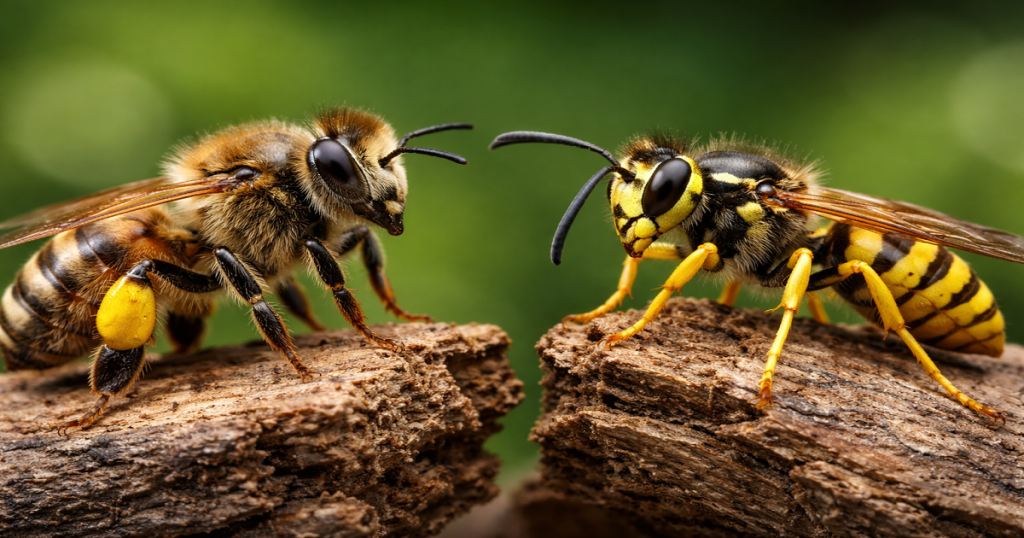
Honey Bees
Honey bees live in large colonies and may appear around lights if their hive becomes disturbed.
Bumblebees
Bumblebees usually stop flying after sunset and rarely gather near lights.
Carpenter Bees
Carpenter bees sometimes investigate structures near lighting fixtures because they nest in wood.
Do LED Lights Attract Bees?
Modern outdoor lighting often uses LED bulbs, which raises the question: Are bees attracted to LED lights? LED lights generally attract fewer insects than older lighting technologies, but the effect depends on color temperature.
Lights most likely to attract insects include:
- bright white LEDs
- blue-spectrum lighting
- UV-emitting bulbs
Lights that attract fewer insects include:
- warm-colored LEDs, yellow “bug lights.”
- sodium vapor lights
Because insects respond strongly to UV wavelengths, minimizing UV output helps reduce insect attraction.
Comparison: Which Lights Attract the Most Insects?
| Light Type | Bee Attraction | Other Insect Attraction |
| UV lights | Medium | Very high |
| Cool white LED | Low–medium | High |
| Warm LED | Low | Moderate |
| Yellow bug light | Very low | Low |
Switching to warmer lighting is one of the easiest ways to reduce insects around porch lights.
Step-by-Step: How to Stop Bees From Coming to Lights
If bees frequently gather around your outdoor lighting, these steps can help.
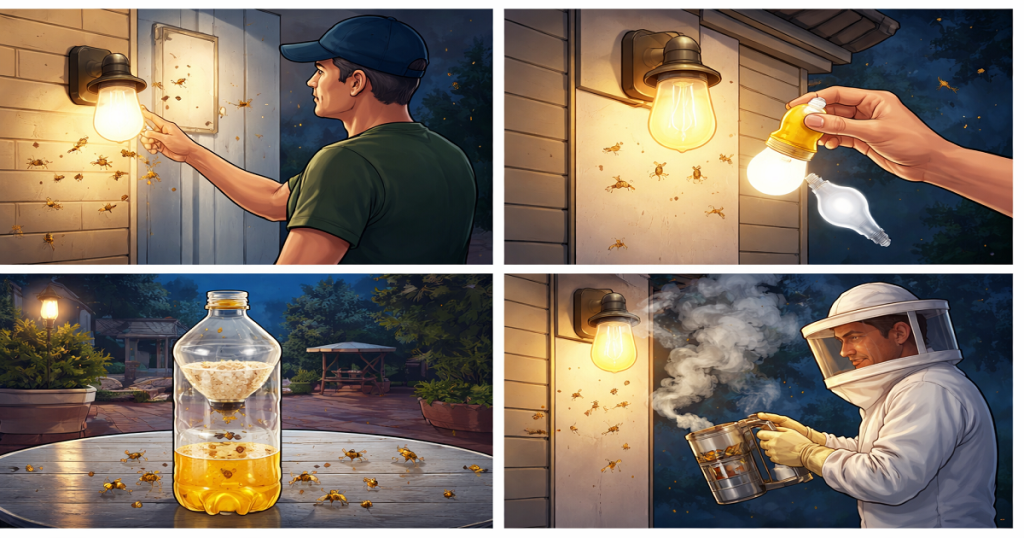
Step 1: Replace Bright White Bulbs
Switch to warm LED or yellow bug lights, which emit wavelengths that attract fewer insects.
Step 2: Use Shielded Lighting Fixtures
Downward-facing lights reduce visibility to insects and minimize attraction.
Step 3: Reduce Unnecessary Lighting
Turn off outdoor lights when they are not needed or install motion-sensor lighting.
Step 4: Check for Nearby Hives
Inspect areas such as:
- roof eaves
- wall cavities
- attic spaces
- nearby trees
Bee activity around lights may indicate a hidden hive nearby.
Step 5: Contact a Professional Bee Removal Service
If a colony has established itself near your home, professionals can safely relocate the hive without harming pollinators.
Professional Insights From Pest Control Experts
Experienced pest control professionals often see homeowners misunderstand bee behavior around lights.
Common mistakes include:
- using insecticide on beneficial pollinators
- attempting to remove hives without protective equipment
- leaving bright security lights on all night
Best practices recommended by pest control experts include:
- using insect-safe outdoor lighting
- sealing small structural gaps where bees could nest
- relocating colonies rather than exterminating them
These approaches align with Integrated Pest Management (IPM) principles, which focus on long-term prevention while protecting beneficial species.
Frequently Asked Questions
Why are bees flying around my porch light at night?
This usually happens when bees become disoriented due to hive disturbance or bright artificial lighting nearby.
Do honey bees come to light at night?
Honey bees normally return to their hive before dark. If they appear near lights, they are likely disoriented.
Are bees attracted to LED lights?
LED lights attract fewer insects than older bulbs, but cool white LEDs may still attract some insects.
Do yellow porch lights repel bees?
Yellow “bug lights” reduce insect attraction by emitting wavelengths that insects are less sensitive to.
Why are bees entering my house through the lights?
Bees may accidentally follow indoor lighting through open windows or doors if they become disoriented outside.
What lights attract insects the most?
Lights that emit ultraviolet or blue wavelengths attract the highest number of insects.
Are bees active at night?
Most bees are daytime pollinators and are inactive after sunset.
How can I prevent bees near outdoor lights?
Use warm-colored bulbs, reduce outdoor lighting, and inspect your property for nearby hives.
Conclusion
So, are bees attracted to light? In most cases, the answer is no.
Bees are daytime pollinators that rely on sunlight and environmental cues to navigate. However, unusual conditions—such as hive disturbance, swarming behavior, or bright artificial lighting—can sometimes cause bees to gather near lights.
Understanding bee vision, navigation, and insect phototaxis helps explain why these encounters occasionally occur. Fortunately, simple steps such as switching to warm LED bulbs, reducing outdoor lighting, and checking for nearby hives can effectively prevent bees from gathering around lights.
Because bees play a critical role in pollination and ecosystem health, the best approach is always one that protects both your home and these important pollinators.